

Hey folks, it’s Dan the Price Man here, your go-to guy for cutting through the BS on all things politics, economics, and the wild world we’re living in.
Today, we’re diving headfirst into a topic that’s exploding right now:
Venezuela, its tangled history with the US, the bombs dropping as we speak, and why the hell Venezuelans are out in the streets partying like it’s the end of a nightmare over the takedown of Maduro and that military base.
This isn’t some distant drama; it’s a pressing crisis that screams everything wrong with socialist dictatorships and why we need bold, individualistic action to smash them.
I fully support what just went down – the US stepping in to liberate a nation from a tyrant who’s starved his people, crushed freedoms, and turned a resource-rich country into a hellhole.
As an individualist conservative, this hits home for me. My brand of conservatism isn’t about clinging to dusty traditions or waving flags for nostalgia’s sake.
It’s about you – the individual – being free to chase your dreams without some power-hungry bureaucrat or corrupt regime breathing down your neck.
It’s hardcore progress: nuclear plants lighting up cities, breakthroughs in tech and science without endless regulations, and yes, taking out threats that poison our backyard with drugs, migration chaos, and instability.
This Venezuela mess?
It’s personal for my political identity because it shows what happens when we let collectivist garbage like Maduro’s socialism run wild.
I’ve seen Gen Z kids grinding through college debt, Millennials stuck in gig jobs because the economy’s been strangled by bad policies – imagine that amplified to famine levels.
We’re witnessing the pains of a generation in Venezuela who’ve lost everything to this regime, and it’s a wake-up call for us.
No more tiptoeing around; we need leaders who act decisively. Stick with me here – I’m about to lay out a detailed exploration, connecting this to bigger issues like global freedom, energy independence, and why America must lead without apology.
We’ll break down the history, the mechanics of the current strikes, the wins and risks, key players pulling strings, private sector roles, the latest news as of this week in January 2026, and end with a call to join me in forging a future that actually empowers people, not chains them. Buckle up; this is gonna be thorough.
Let’s start at the roots.
Venezuela and the US have a relationship that’s older than most folks realize, stretching back over two centuries.
It kicked off in the early 1800s when Venezuela was fighting for independence from Spain.
Simon Bolivar, the liberator dude, was all about shaking off colonial yokes, and the US, fresh off its own revolution, saw a kindred spirit.
We recognized Venezuela’s independence in 1835, right after they split from Gran Colombia. Diplomatic ties were formal – our first chargé d’affaires, John G.A. Williamson, showed up in Caracas that year, and we inked a commercial treaty in 1836.
Back then, it was all about trade: Venezuela had coffee, cacao, and hides; we had manufactured goods.
Smooth sailing, right? Not quite. Even early on, there were hiccups. In the 1890s, a border dispute with Britain over Guyana territory pulled the US in.
President Grover Cleveland invoked the Monroe Doctrine – that “no European meddling in the Americas” policy from 1823 – and backed Venezuela, forcing arbitration that mostly favored them.
It was a flex for emerging US power, showing we’d protect hemispheric sovereignty.
Fast forward to the 20th century, and oil changes everything.
Venezuela discovers massive reserves in the 1910s-1920s, becoming a top exporter. US companies like Standard Oil (later Exxon) pour in, building infrastructure and basically running the show under dictators like Juan Vicente Gomez.
Gomez was a US buddy – he let American firms exploit the oil, and in return, we turned a blind eye to his brutality.
But here’s where meddling ramps up: In 1908, during a Dutch-Venezuelan crisis over debts, the US Navy helped Gomez seize power in a coup.
Yeah, we facilitated a dictator because it suited our interests. This pattern repeats. By the 1950s, under Marcos Perez Jimenez, another strongman, US ties were tight – he was anti-communist during the Cold War, so Eisenhower gave him the Legion of Merit.
But Jimenez was corrupt as hell, jailing opponents and siphoning oil money. Venezuelans overthrew him in 1958, ushering in democracy.
The democratic era from 1958 to 1998 was golden for relations – stable governments, oil flowing, and Venezuela as a US ally in OPEC, even helping during the 1973 embargo by selling us crude.
But cracks showed: Economic inequality festered, corruption boomed, and IMF austerity in the 1980s sparked riots like the Caracazo in 1989, killing hundreds.
Enter Hugo Chavez in 1992 – a lieutenant who tried a coup, failed, but won hearts with his anti-elite rhetoric. Elected in 1998, Chavez launched his “Bolivarian Revolution,” nationalizing oil, bashing the US as “imperialist,” and cozying up to Cuba, Iran, and Russia.
He survived a 2002 coup that the US tacitly supported – Bush knew about it via CIA briefs but didn’t warn him, and we initially recognized the interim government before backpedaling when Chavez returned amid massive protests.
Chavez’s Venezuela era (1999-2013).
He accused the US of plotting against him, expelled ambassadors, and used oil money for social programs that lifted millions from poverty but wrecked the economy long-term through mismanagement and corruption.
When Chavez died in 2013,Nicolas Maduro took over – his handpicked successor. Maduro doubled down on socialism, but without Chavez’s charisma or high oil prices, things collapsed.
Hyperinflation hit 1 million percent by 2018, food shortages starved people, and crime skyrocketed. Over 7 million fled, creating a refugee crisis that’s hammered neighbors and even reached our borders.
US response?
Sanctions started under Obama in 2015 targeting officials for human rights abuses and drug trafficking – Maduro’s inner circle was neck-deep in narco stuff via the “Cartel of the Suns.”
Trump cranked it up from 2017: Broader sanctions on PDVSA (state oil company), blocking debt restructuring, and recognizing Juan Guaido as interim president in 2019 after Maduro’s fraudulent reelection.
Nearly 60 countries followed suit, but Maduro clung on with Russian, Chinese, and Iranian backing.
We seized assets, indicted Maduro for narcoterrorism in 2020, and offered a $15 million bounty.
Biden kept most sanctions but eased some for oil in 2022-2023 after talks, only to reimpose them when Maduro barred opposition candidates for 2024 elections.
Maduro “won” again in July 2024 amid fraud claims, sparking protests he crushed, killing dozens.
That brings us to the escalation in late 2025-early 2026.
Tensions boiled over with US military moves: Strikes on drug boats in the Caribbean starting September 2025, seizing Venezuelan oil tankers, and a buildup off the coast.
Trump, back in office, wasn’t playing – he warned Maduro to step down or face consequences.
Reports say a December 2025 bombing of a drug base inside Venezuela was a test run, with US jets probing airspace.
Then, boom: January 3, 2026, Operation Absolute Resolve launches. At 2:01 AM local time, over 150 US aircraft, plus land and sea forces, hit targets in Caracas and north Venezuela. Key: La Carlota military air base got wrecked – anti-aircraft units destroyed, buildings leveled. They shot students.

U.S. hit Venezuela with ‘large-scale strike,’ captured Nicolás …
Maduro and wife Cilia Flores were captured at their Fort Tiuna home, flown out on the USS Iwo Jima to face charges in New York.
Trump announced it at 4:21 AM ET, saying we’d “run” Venezuela until a transition. Venezuelan VP Delcy Rodriguez demanded proof of life; state TV declared emergency.
Why the bombs and war? Officially, narcoterrorism – Maduro’s regime trafficked tons of coke through Venezuela, funding itself and allies like Hezbollah.
But deeper: Humanitarian crisis, with 80% poverty, kids dying of malnutrition, and migration flooding the US (over 1 million Venezuelans crossed our border since 2021).
Strategically, Venezuela’s oil – world’s largest reserves – but production tanked under Maduro from 3 million to under 800k barrels/day.
Trump eyes rebuilding with US firms like Chevron (already licensed back in).
Politically, it’s about curbing Russian/Chinese influence – they’ve loaned billions, built bases. This isn’t endless war like Afghanistan; it’s targeted to free a neighbor.
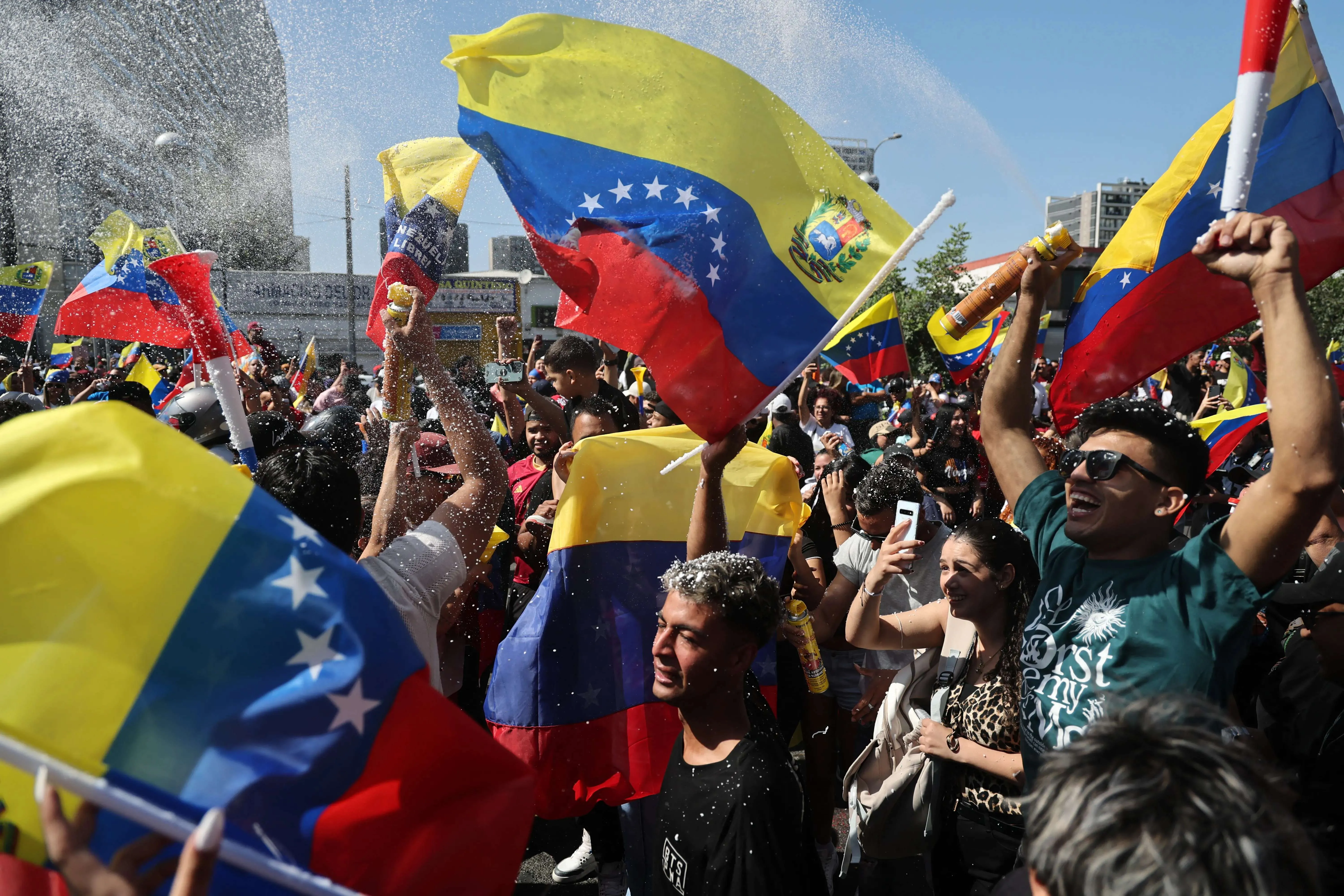
Now, why are Venezuelans celebrating Maduro’s downfall and the base’s destruction? Videos flood X: Millions in streets, waving flags, chanting “Libertad!”

Venezuelans living around the world reacted with celebrations …
It’s the end of 25 years of Chavismo’s oppression.
Under Maduro, socialism meant price controls causing shortages, nationalizations bankrupting industries, and repression via colectivos (armed thugs) and SEBIN torturing dissidents.
Hyperinflation wiped savings – a month’s wage buys a carton of eggs. Starvation? UNICEF says 1 in 3 kids malnourished.
Crime? Caracas was murder capital. The military base at La Carlota symbolized regime power – it housed elite units crushing protests.
Its destruction? A cathartic blow to the machine that jailed, killed, and exiled opponents. Exiles in Madrid, Miami celebrate too – warily, but hopeful.

Private entities: Oil giants like Chevron, Exxon – sanctions denied payments, but now Trump’s plan lets them rebuild infrastructure, potentially denying rivals access. We’re getting 1$ gas.
Latest news, January 3, 2026: Trump presser from Florida – we’ll run it till transition, focus on oil. Caracas in shock, but celebrations grow. World reacts: UK PM Starmer neutral-ish, but photos show destroyed base.
Venezuela is free.


Leave a Reply