

Hey folks, it’s Dan The Price Man. Look, I can support Trump with some of his decisions, but the whole thing with Epstein seemed to be a backstab to his voters at first. At first.
But then recently I saw that recently Kevin Spacey and the House Democrats are forcing and calling to release the files. That got me thinking, if someone such as Kevin Spacey demands the files right then and now, what does that mean for the files directly?
I have no doubts that the files or client list exists, but what’s strange is how the whole mood towards them shifted from “We have them, on my desk” to “The files don’t exist.”

Now, is this Trump at play doing something? It could be. But what if it isn’t? What if there’s something greater at play with the Epstein files that we don’t, or can’t, see?
Something’s Wrong With The Epstein Files.
The name Jeffrey Epstein hits like a punch to the gut—a twisted emblem of wealth, power, and the kind of depravity that keeps you up at night. He was a financier who waltzed through life alongside presidents, princes, and billionaires, a man whose Rolodex was as golden as his private jet.
But beneath the glitz was a monster, one who sexually abused dozens of underage girls—some as young as 14—leaving scars that time can’t erase.
His death in 2019, stamped as a suicide but almost everyone knows to be murder, didn’t close the book; it ripped it wide open.
Now, in July 2025, the story’s still a live wire. House Democrats, with warriors like Jamie Raskin at the helm, are pounding the table for Epstein’s client list to see the light of day.

Then there’s Kevin Spacey—yeah, that Kevin Spacey—throwing his own disgraced voice into the mix, demanding the files drop.

Meanwhile, the Trump administration’s handling of these “Epstein Files” feels like a bad magic trick: partial releases with no meat, a DOJ memo swearing there’s no client list, and a whole lot of smoke.

What’s the deal? Are the files gone, scrubbed clean, or locked away as leverage in some shadowy game?
I’m no stranger to fighting for control—against my own body, against the doubts that creep in, against a world that wants to keep you small and quiet.
I’ve stared down my own struggles, and that’s why this story gets under my skin—I see the smoke because I’ve walked through fire. This isn’t just some scandal to skim and forget; there’s something wrong.
Is it a human cry for justice, a mirror showing the rot in our systems, and a testament to survivors who refuse to let their voices die?
Or is something else at play here?
Grab a coffee, settle in, and let’s dig deep.
Epstein’s Early Life and Career

Jeffrey Edward Epstein came into the world on January 20, 1953, in Brooklyn, New York, born to Seymour and Paula Epstein—a couple who knew the grind of survival all too well.
Seymour was a groundskeeper for the city’s Parks Department, the kind of guy who’d spend his days patching up busted swings and worn-out benches in Coney Island, hands rough from work, face weathered by the salt air.
Paula was a school aide, her days filled with the chaos of corralling kids, grading papers, and stretching a paycheck to cover the bills.
They lived in a modest slice of Brooklyn—picture a cramped apartment with creaky floors, faded wallpaper peeling at the edges, and a kitchen table cluttered with hand-me-downs that carried the faint smell of mothballs.
It was a life of scraping by, the hum of a restless city seeping through thin walls, a place where dreams were big but the path to them was narrow.
Epstein grew up in this rough-and-tumble world, a kid shaped by the concrete jungle of Coney Island.
He went to Lafayette High School, where he stood out—not for sports or popularity, but for a razor-sharp mind that devoured math problems like they were puzzles begging to be cracked.
Teachers noticed his knack for numbers, but he wasn’t the type to sit still for gold stars or diplomas. He had hustle in his blood, a restless energy that pushed him to chase the next rung on the ladder, no matter how shaky it looked.
By 16, in 1969, he’d talked his way into Cooper Union, a prestigious spot to study physics—a bold leap for a Brooklyn boy with no fancy lineage. But two years in, the slow churn of lectures and lab coats bored him stiff.
He dropped out, hungry for something faster, something real. He gave it another shot at NYU’s Courant Institute, diving into mathematical physiology—fancy stuff about how numbers explain the body—but again, no degree.
Epstein wasn’t built for the long game of academia; he wanted the world, and he wanted it now.
At 21, in 1974, he landed a gig that raised eyebrows: teaching math and physics at the Dalton School, a ritzy Manhattan prep school where the elite sent their kids. No college degree? No problem.
Epstein had charm that could open doors and a confidence that made you forget the rules. Picture him in front of a chalkboard, tie slightly askew, cracking jokes to a room of privileged teens, his Brooklyn edge softened just enough to fit in. He was young, magnetic, the kind of teacher kids remembered.
But there were shadows—whispers from students about him getting too close, crossing lines that shouldn’t be crossed. In 1976, they cut him loose.
Officially, it was “poor performance,” but the rumors told a different story: inappropriate behavior with kids, a warning sign of the darkness to come.
If you’ve ever had a gut feeling about someone that you couldn’t shake, you know how those whispers must’ve felt to the Dalton parents who heard them.
Epstein didn’t flinch. He pivoted hard into finance—a world where hustle trumped parchment. A Dalton parent, a big shot at Bear Stearns, saw something in him—maybe that raw ambition—and pulled him into the investment bank in 1976.
He started as a junior assistant, a nobody in a sea of suits, but his math skills and relentless drive turned heads fast.
By 1980, he was a limited partner, advising millionaires on options trading, swimming with Wall Street’s sharks and holding his own.
He had a predator’s instinct, a way of reading people and markets that made him dangerous. But in 1981, he was out—kicked to the curb for reasons that stayed murky.
Regulatory violations? A power play gone wrong? No one’s talking, but Epstein didn’t care. In 1982, he launched J. Epstein & Co., a shadowy firm that only took clients with a billion bucks or more.
His golden ticket? Les Wexner, the retail king behind Victoria’s Secret and Bath & Body Works. Epstein became Wexner’s money whisperer, managing his fortune and even snagging power of attorney—a bond so tight it felt like a pact sealed in secrets.
By the 1990s, Epstein was a financial ghost, his wealth piling up in ways that didn’t add up on paper. His Manhattan townhouse on East 71st Street was a seven-story fortress worth $50 million, a “gift” from Wexner that screamed hidden strings.
He scooped up a Palm Beach estate where the sun shined on his sins, a sprawling New Mexico ranch that felt like a dictator’s retreat, a Paris apartment with a view of the Seine, and Little St. James—a private island in the U.S. Virgin Islands that locals started calling “Pedophile Island” in hushed, knowing tones.

His jet, dubbed the “Lolita Express,” crisscrossed the globe, a flying symbol of his untouchable life. But how’d he bankroll it all? His firm was a black box—asset management, consulting, maybe something dirtier.
Whispers of money laundering or backroom deals followed him like a bad smell, but no one could pin it down. What shone through was his gift for networking, weaving a web of influence that pulled in the world’s biggest names—a web that’d one day strangle him.
Epstein’s Criminal Underworld
Epstein’s crimes weren’t a slip-up or a scandal gone rogue—they were a cold, calculated empire built on exploiting the powerless.
It all cracked open in March 2005, when a desperate call hit the Palm Beach Police Department: a mother, voice trembling, said Epstein had sexually abused her 14-year-old daughter at his mansion.

That call wasn’t just a spark; it was a match dropped on gasoline. The investigation peeled back layers of horror, revealing a network of abuse that stretched back to the 1990s.
Detectives tracked down dozens of girls—high schoolers, mostly—lured to Epstein’s Palm Beach estate with promises of easy cash: $200-$300 to give “massages.” But those weren’t massages.
They were assaults—intercourse, oral sex, molestation—forced on girls as young as 14, kids who should’ve been worrying about homework, not surviving a predator’s touch.
These weren’t random targets. Epstein and his crew, spearheaded by Ghislaine Maxwell—his right hand and alleged pimp—hunted the vulnerable with a sniper’s precision.
Runaways with no one to run to. Foster kids shuffled through a broken system. Girls from families so strapped that $200 felt like a lifeline.
Imagine being 14, your stomach growling because there’s no food at home, and someone offers you a way out—only to trap you in a nightmare. That’s the gut punch of it: he didn’t just prey on them; he weaponized their desperation.
One girl later told police she’d show up in her school uniform—plaid skirt, sneakers still muddy from the bus stop—and leave with cash and a hollowed-out soul.
Another said Maxwell taught her how to “please him,” a twisted lesson no kid should ever learn.
By May 2006, Palm Beach cops had a mountain of evidence—enough to slam Epstein with multiple counts of unlawful sex with a minor.
But State Attorney Barry Krischer pulled a move that still stinks: he punted the case to a grand jury, a rare step that watered down the charges to one measly count of solicitation.
Enter the FBI in 2007, digging deeper and finding at least 36 victims, some spilling stories that’d make your blood run cold—like being paid extra to bring friends, a sick pyramid scheme of trauma.
It was headed for a federal showdown, but in 2008, Epstein’s legal dream team—big names like Alan Dershowitz and Kenneth Starr—worked a deal with U.S. Attorney Alexander Acosta that felt like a middle finger to every victim.
Epstein copped to state charges: procuring a minor for prostitution and soliciting a prostitute. His punishment? Thirteen months in a cushy county jail with work release—12 hours a day, six days a week, free to strut back to his mansion at night.
Thirteen months for decades of ruin. The deal’s kicker? Immunity for “any potential co-conspirators,” a shield for Maxwell and whoever else was in the shadows. Outrage doesn’t even cover it.
The victims? They were furious, heartbroken, betrayed. Virginia Roberts Giuffre’s story cuts deepest: she was 15, working a summer job when Maxwell scooped her up like a prize.
Giuffre later said she was trafficked to Epstein’s buddies, including Prince Andrew, her innocence traded like currency.
The plea deal was so hush-hush, victims weren’t even told—imagine finding out the man who stole your childhood got a slap on the wrist through a news ticker.
Lawsuits flew, claiming the feds broke the Crime Victims’ Rights Act, a legal scream for justice.
Then came the 2018 Miami Herald series “Perversion of Justice,” a gut-wrenching exposé by Julie K. Brown that named 80 victims—some abused as far back as 1996—and laid bare how Epstein’s money and connections twisted the system.
It torched Acosta’s career—he quit as Trump’s Labor Secretary in 2019—and lit a fire under the public, showing Epstein as a predator the powerful couldn’t bear to cage.
The Elite Network: Epstein’s Web of Influence
Epstein’s real currency wasn’t cash—it was connections, a network so vast it felt like he held the world on a leash. His Rolodex was a hall of fame and infamy, names that’d make your jaw drop.
He wined and dined them at his properties or whisked them away on the “Lolita Express,” his private jet that became a legend of its own.
The flight logs, unsealed later, are a who’s-who of power: Bill Clinton logged 26 trips from 2001 to 2003, often ditching his Secret Service detail, a choice that still raises hackles.

Donald Trump, who lived down the road at Mar-a-Lago, hopped on at least once in 1997 and gushed in 2002 that Epstein was a “terrific guy” who liked his women “on the younger side”—words that echo like a bad omen now.

Prince Andrew was a regular, later accused by Giuffre of assaulting her at 17; he denied it, but a $16 million settlement in 2022 spoke louder.

Then there’s Bill Gates, meeting Epstein for “philanthropy” chats he’d later regret; Leon Black, shelling out $158 million for Epstein’s financial “advice”; Woody Allen, popping by the townhouse; even Stephen Hawking, rolling into a 2006 island conference.

None faced charges, but their closeness to the flame begged questions: what did they see? What did they choose not to?
Epstein’s parties were the stuff of dark fairy tales—extravagant nights where champagne flowed and young women, some barely legal, others not, were part of the decor.
His Manhattan townhouse, a $50 million monster from Wexner, hosted dinners where brainiacs rubbed elbows with models—a surreal mash-up of brilliance and exploitation.
Little St. James was the deep end, a private island where allegations of orgies and abuse painted a picture of a man untethered from morality.
Giuffre swore Epstein rigged these scenes to trap people—cameras rolling, secrets captured, a blackmail playbook to keep the mighty in line.
No tapes have surfaced, no smoking gun, but his cryptic quip, “I invest in people,” lingers like a threat.
I’ve known people like that—smooth talkers who collect favors like trophies, always holding something over you. It’s a gut feeling you can’t shake.
His financial grip was just as tight. Wexner handed him the keys to a $1 billion kingdom, a trust so complete it boggled the mind—power of attorney, total control, a bond that felt more like a deal with the devil.
Epstein played “fixer” for billionaires—untangling tax messes, brokering deals—making himself the guy you couldn’t cut loose.
When the 2005 probe hit, that network didn’t save him outright, but it cushioned the fall. That plea deal?
It’s the stench of privilege, a get-out-of-jail card most of us could never dream of. It’s the kind of break that makes you wonder: how many others got away because they knew the right people?
Arrest and Death
July 6, 2019, was the day Epstein’s house of cards finally toppled. FBI agents swarmed Teterboro Airport in New Jersey, nabbing him as he stepped off his jet from Paris—a cinematic takedown that felt like justice catching up.

The charges were heavy: sex trafficking of minors and conspiracy, pinning him for a web of abuse from 2002 to 2005 across New York and Florida.
Prosecutors said he paid girls to perform sex acts and rope in others, a “vast network” of victims, some just 14—kids who deserved playgrounds, not predators.
His $250 million fortune and private islands screamed flight risk, so bail was a no-go. They locked him in the Metropolitan Correctional Center (MCC), a concrete tomb in Manhattan, a far cry from his marble mansions and island escapes.
On July 23, 2019, the plot thickened—he was found in his cell, neck bruised, a so-called suicide attempt that landed him on watch.
But six days later, they pulled him off—a call that baffled anyone with a shred of sense. Then, August 10, 2019, 6:39 a.m.: guards found him lifeless, dangling from his bunk with a bedsheet noose.

CPR couldn’t bring him back; he was gone, pronounced dead at New York Downtown Hospital. Dr. Barbara Sampson’s autopsy called it suicide by hanging, pointing to a broken hyoid bone—a detail common in hangings but also strangulations, a crack in the story that let doubt flood in.
The scene was a mess of red flags. Two cameras outside his cell? Both crapped out—convenient, right?
Guards Tova Noel and Michael Thomas, supposed to check every 30 minutes, were caught napping or scrolling online, faking logs like it was no big deal—they’d later face charges for conspiracy and falsifying records.
His cellmate got moved out hours before, leaving him solo—against every rule for a guy like him. That hyoid break? Rare in suicides for a 66-year-old, more common when someone’s choked out.
Epstein’s lawyers, led by Reid Weingarten, brought in pathologist Michael Baden, who didn’t buy it—called it “highly unusual” for a suicide, hinting at something darker.
The public smelled it too—polls pegged 60% of Americans calling BS on the official line. I’ve had nights gaming with buddies, arguing over this, all of us feeling the same itch: this doesn’t add up.
Murder or Suicide?

The murder theory isn’t some wild Reddit thread—it’s built on holes you could drive a truck through.
Forensic experts say a broken hyoid shows up in 50% of strangulations but just 15% of hangings for guys Epstein’s age, stats that don’t lie easy.
Both cameras failing at once? In a high-security joint, that’s not bad luck; that’s almost divine intervention. The guards’ screw-up feels like a setup, too perfect to be random.
Epstein wasn’t just a rich creep; he was a liability, a guy whose trial could’ve dragged CEOs, senators, maybe even royalty into the mud.
Theories swirl: a hitman slipping past sleeping guards, or spooks—Mossad, CIA—tying up loose ends to protect their own.
His cell didn’t help—high bunk, no clear anchor for a sheet, a 6-foot guy supposedly rigging a noose in a space built to stop that exact thing. It’s the kind of puzzle that keeps you up, replaying the what-ifs.

The official story fights back, but it’s shaky. The DOJ’s 2020 Inspector General report chalked it up to “staffing shortages” and “procedural failures”—bureaucratic blah-blah that explains nothing.
Baden admitted the hyoid break wasn’t a smoking gun—suicides can look like strangulation if the drop’s right. MCC’s cameras were a known mess, with 20% down that year, a glitch not a plot. Guards slacking?

Federal jails were a dumpster fire of understaffing, a chronic ache. But the doubts don’t die: why yank suicide watch after six days? Why no cellmate, breaking protocol? Why zero oversight for a case this loud?
Don’t forget how a whole 24 hour livestream came out to say “he committed suicide”. But keen watchers noticed how there’s exactly one minute missing from 11:58:59 to 12:00:00.

The public’s trust is shot—70% in a 2023 Gallup poll said they’re not buying it. I get it. After years of watching systems fail the little guy, from welfare lines to courtrooms, I feel that same burn of disbelief.
The Epstein Files: What Are They?

The “Epstein Files” sound like a spy novel, but they’re real—a messy pile of court docs, FBI reports, flight logs, emails, and that infamous “black book” of contacts.
They’ve trickled out in waves—2019, 2021, 2024, 2025—each batch peeling back a little more skin.
You’ve got victim testimonies that break your heart, Maxwell’s trial records that read like a crime saga, and evidence lists that chill the blood—like a CD from his mansion marked “girl pics nude book 4,” a snapshot of his sickness.
The 2024 drop named big shots—Clinton, Trump, Spacey—but didn’t pin crimes on them, leaving us squinting at shadows.
Let’s talk about Trump for a second here. You know that if his name was on that list, you know DAMN WELL that every single media/news outlet would be on it like flies to rotten food.
It wouldn’t stop at all, 24/7 coverage everywhere, anywhere. But, consider how there hasn’t been anything like that, that means two possibilities.
- Trump’s name isn’t on that list at all.
- Both Democrat and Republicans are working together to make sure his name isn’t released.
Then came 2025’s “Phase 1” under Attorney General Pamela Bondi—200 pages of recycled noise, per a February 2025 NPR report.
A July 2025 DOJ memo doubled down: no “client list,” no blackmail stash exists. It’s a claim that feels like a dodge, a door slammed shut when we’re still knocking.
What’s in there? It’s a fog of half-truths. Some swear there’s a master list—names of men who paid for or joined in the abuse, a roll call of the damned.
Giuffre’s said Epstein filmed it all, a digital arsenal of kompromat to bend the powerful to his will. But 2025’s whimper of a release—no new meat, just bones—has people yelling: destroyed? Sanitized? Hoarded for leverage?
The DOJ’s “exhaustive review” sounds like a PR line, and with the FBI’s track record—think Hoover’s secret files—it’s hard not to wonder who’s holding the cards.
The Trump Administration’s Bizarre Dance

By July 2025, the Trump administration’s tango with the Epstein Files is a head-scratcher—a mix of bold talk and empty hands. Trump ran in 2024 vowing to “lift the veil” on Epstein, a promise that fired up his base like a rally chant.
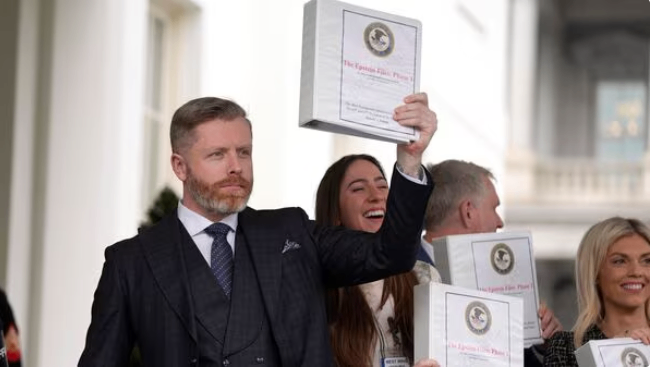
February 2025 saw Bondi roll out “Phase 1,” handing binders labeled “The Epstein Files” to right-wing voices like Chaya Raichik and Liz Wheeler—pure theater, right down to the photo ops. But flip through those pages?
Flight logs, Maxwell’s notes, an evidence list—old, redacted, and about as revealing as a blank wall. X lit up with fury; Rep. Eric Swalwell’s tweet nailed it: “You were promised the full Epstein files. You got this.”
Bondi swore more was coming, pointing fingers at the FBI for holding back thousands of pages, but by July, the DOJ said, “That’s it, folks.” Trump’s July cabinet quip—“Are you still talking about this creep?”—landed like a shrug, not a stand, and it stung.
It’s a flip-flop that reeks of retreat. Trump milked Epstein conspiracies to win votes, but the 2025 releases were a letdown—a betrayal of the fire he stoked.
Why pull back? Some say he’s guarding allies—his name’s in the files, even if it’s not dirty, a ghost he can’t outrun.
Others blame infighting: the FBI, led by Kash Patel, butted heads with Bondi, per a July 2025 ABC News scoop, a turf war that buried progress.
The DOJ’s “no client list” line clashes with earlier hints of a wider net, and it’s got people—me included—feeling played.
House Democrats

House Democrats, with Jamie Raskin swinging the bat, aren’t letting this fade. On July 8, 2025, Raskin and 15 others fired off a six-page letter to Bondi, accusing her of burying files to protect Trump—a charge with teeth.
They demanded every scrap mentioning him, leaning on Elon Musk’s June 2025 X post claiming Trump’s name explains the stall. Raskin’s a scrapper—his impeachment battles prove he doesn’t blink—so this isn’t just noise.
But it’s a split screen: some see a crusade for victims, a push to right wrongs; others smell a political hit, a jab at Trump’s armor.
A February 2025 X post by @ImMeme0 flipped it, saying Sen. Dick Durbin’s blocking releases to shield Democrats—a counterpunch that muddies the water. Truth is, both sides might be flexing—Dems for points, GOP for cover—while victims wait in the crossfire.
The client list fixation’s a loaded gun. If it’s real, it could torch dozens—politicians, CEOs, celebs—flipping power on its head, a reckoning we’ve craved.
If it’s a myth, as the DOJ insists, this could fizzle into a partisan circus. Either way, the victims deserve more than games, and the public’s hunger—80% want transparency, per a 2025 YouGov poll—is a roar that’s only getting louder.
Kevin Spacey’s Curveball: Why Now?

Kevin Spacey’s July 15, 2025, X post—“Release the Epstein files. All of them. For those of us with nothing to fear, the truth can’t come soon enough”—landed like a thunderclap.
Named in 2024’s unsealed docs with DiCaprio and Blanchett, he’s not tied to crimes, but his own baggage—sexual misconduct allegations, some involving minors—casts a long shadow.
Cleared in a 2023 UK trial, he’s still a Hollywood outcast, his career a smoldering wreck. So why pipe up? Maybe he’s betting the files clear him, a shot at clawing back some dignity.
Or it’s a chess move—dodging scrutiny or hinting he’s got dirt to spill. His “the media already has” dig reeks of a guy tired of guilt-by-association, a stain he can’t scrub off.
It’s a high-wire act from a man who’s played dark games before. Clean files? He’s reborn. Dirty ones? It’s either a bluff or a dare to burn it all down.
Spacey’s not stumbling into this—it’s deliberate, and it’s got the hairs on my neck up, wondering who else is in the crosshairs.
What’s Really Going On?
The Epstein Files are a locked box, and the suspicions—destroyed, edited, or blackmail—hit like truth bombs. Let’s break it down:
- Destroyed Files: The DOJ’s “no client list” could mean the good stuff’s ash. The FBI’s lost evidence before—9/11 files, Clinton emails—a pattern that fits. If elites were named, torching it saves their skins, a clean slate at the cost of justice.
- Edited Files: The 2025 releases were a blackout parade, per ABC News—names, dates, truth snipped out. FOIA fights often end in censored pages; this feels like that, but deliberate, a shield for the untouchable.
- Blackmail Tool: Giuffre’s talk of recordings paints Epstein as a puppet master. If those files live, they’re not evidence—they’re power, held by agencies or insiders playing a long game.
No proof’s surfaced, but the smoke’s choking. The DOJ’s waffling, Spacey’s gambit, Democrats’ heat—it’s a shadow dance, and my gut screams: they’re hiding the payload. The files might not just tell a story; they could rewrite the rules.
Epstein’s legacy is a wound—on justice, on trust, on the human spirit. From Brooklyn’s grit to billionaire excess, his crimes and connections laid bare a system that coddles monsters while survivors pick up the pieces.
His death left us grasping at shadows, but the 2025 fight over the Epstein Files—Democrats’ charge, Spacey’s wild card, the administration’s sidestep—proves that something’s wrong.
This is bigger than one man; it’s about tearing down the walls that protect the powerful.
Hit me up on X at @DanThePriceMan—share your fire, keep this alive. The truth’s out there, and we’re not stopping till it’s ours.



Leave a Reply